
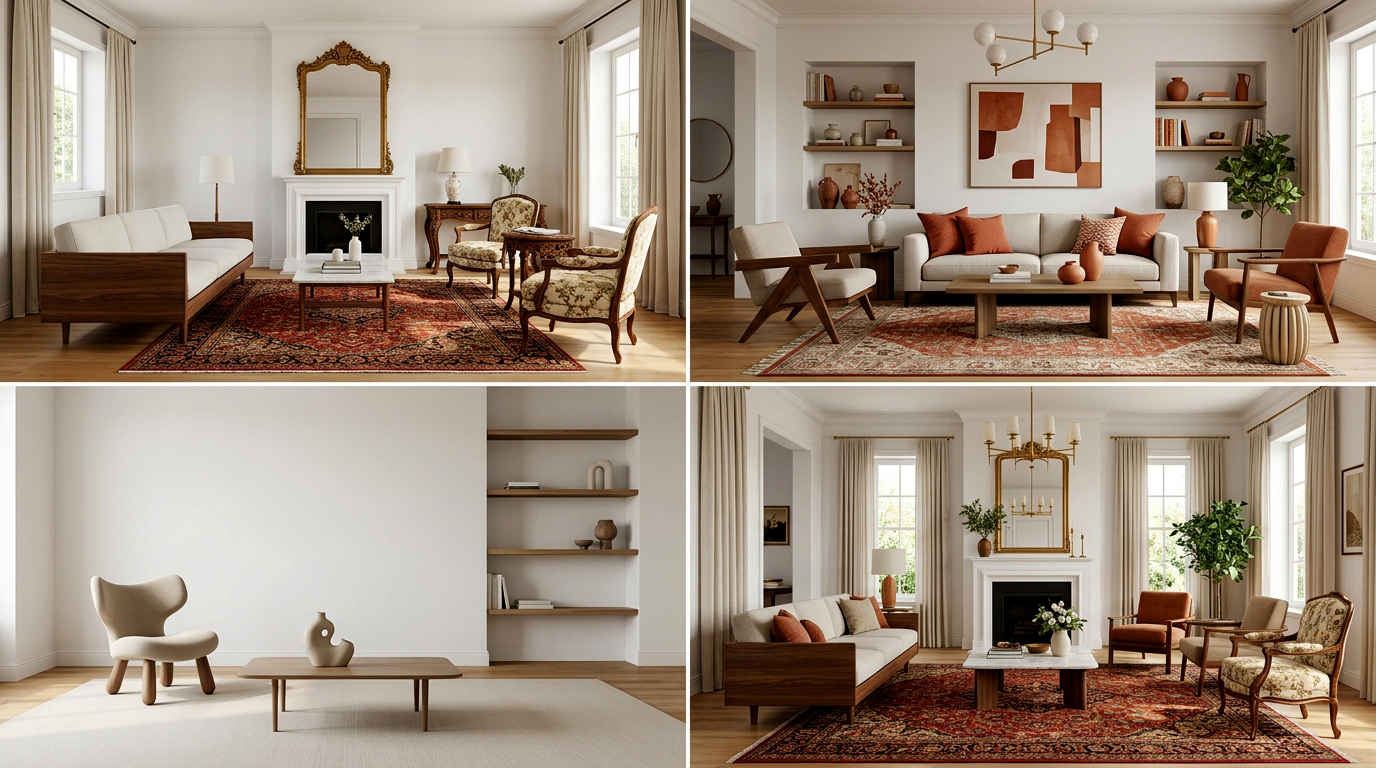
True eclectic design is often deeply misunderstood. For years, the term has been used as a convenient catch-all for spaces that lack a cohesive vision – a polite euphemism for a room where hand-me-down sofas, impulse-buy rugs, and assorted knickknacks collide in a noisy visual pileup. But masterful eclectic decor is the exact opposite of a random collection. It is highly intentional, deeply curated, and requires a sharper editorial eye than the strictest minimalist spaces.
At its core, an eclectic home is a physical manifestation of a well-traveled, widely read, and deeply curious life. It is the art of juxtaposition: placing a sleek, contemporary Italian lighting fixture above a heavily patinated, 19th-century French farmhouse table, and making both pieces look as though they were destined to be together.
Right now, we are witnessing a massive renaissance in this design philosophy. After a decade dominated by stark, greige minimalism and hyper-uniform catalog rooms, the pendulum has swung back toward personality. People are craving homes that feel “collected” rather than “decorated.” We want warmth, history, and spaces that tell a story. Cozy eclectic design provides that deep, tactile comfort without sacrificing high-end aesthetic appeal.
However, walking the tightrope between “wonderfully curated” and “overwhelmingly chaotic” is the greatest challenge of this style. To achieve that coveted, magazine-ready look, you must understand the underlying principles of visual weight, color theory, and spatial planning.
The 3 Rules That Keep Eclectic Decor From Looking Messy
Before you begin moving furniture or buying vintage rugs, you must establish a framework. These three fundamental rules are the invisible architecture that holds an eclectic room together. Ignore them, and the space devolves into clutter. Master them, and you can mix almost anything.
1. The 80/20 Proportion Principle
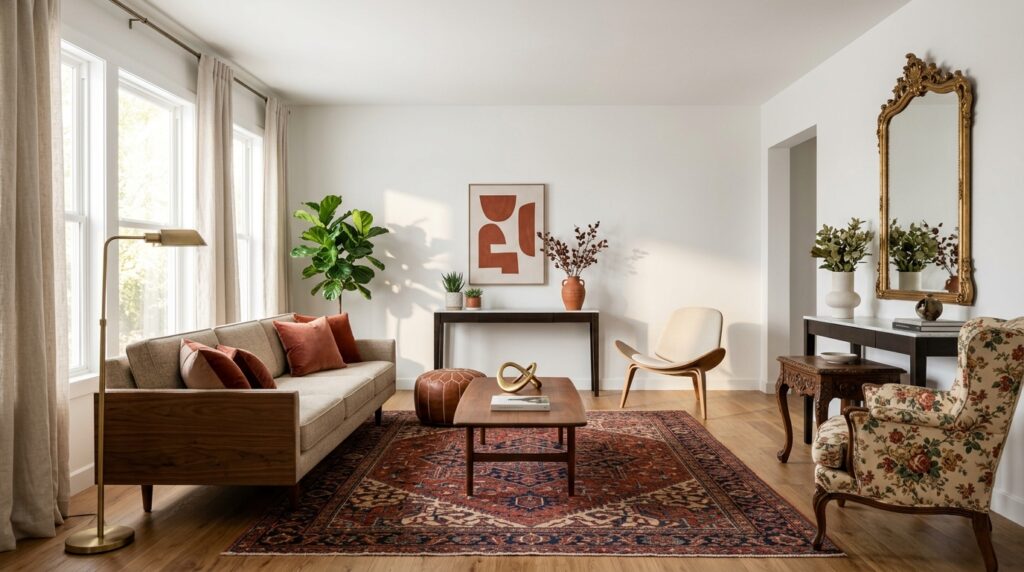
When mixing styles, a 50/50 split will always look like a mistake. It creates a room that is fighting with itself for dominance. Instead, establish a primary style that dictates 80 percent of the room’s foundational pieces – such as the sofa, the wall color, and the window treatments. The remaining 20 percent is where the eclectic magic happens. For example, if your room is 80 percent clean-lined mid-century modern, introduce a 20 percent disruption with an ornate Victorian mirror and a deeply traditional Persian rug. The dominant style grounds the room, while the minority style provides the necessary friction.
2. The Invisible “Red Thread”
Every room needs a “red thread”, a repeating element that ties disparate objects together. In an eclectic space, this thread is almost always color. You can place a brutalist concrete side table next to a delicate, chintz-upholstered armchair, provided they are bound by a shared color palette. If your room features a deep terracotta, ensure that specific hue echoes at least three times around the space: perhaps in a throw pillow, a piece of abstract art on the opposite wall, and the glaze of a ceramic vase. This repetition signals to the brain that the arrangement is intentional.
3. The Necessity of the Void
In a room filled with fascinating, diverse objects, the most important element is the space where nothing exists. Negative space is the palate cleanser that allows the eye to rest and appreciate the curation. If every surface is covered and every wall is filled, the brain registers the environment as chaotic. You must actively design empty spaces. Let a beautiful chair stand alone against a blank wall. Leave the center of your coffee table completely bare. Negative space frames your eclectic pieces and elevates them from clutter to art.
10 Ideas for a Cozy, Cohesive Eclectic Space
With the foundational rules established, we can explore the specific tactics that interior designers use to build rooms rich with layered, cozy eclecticism.
1. Master the Art of Color Anchoring
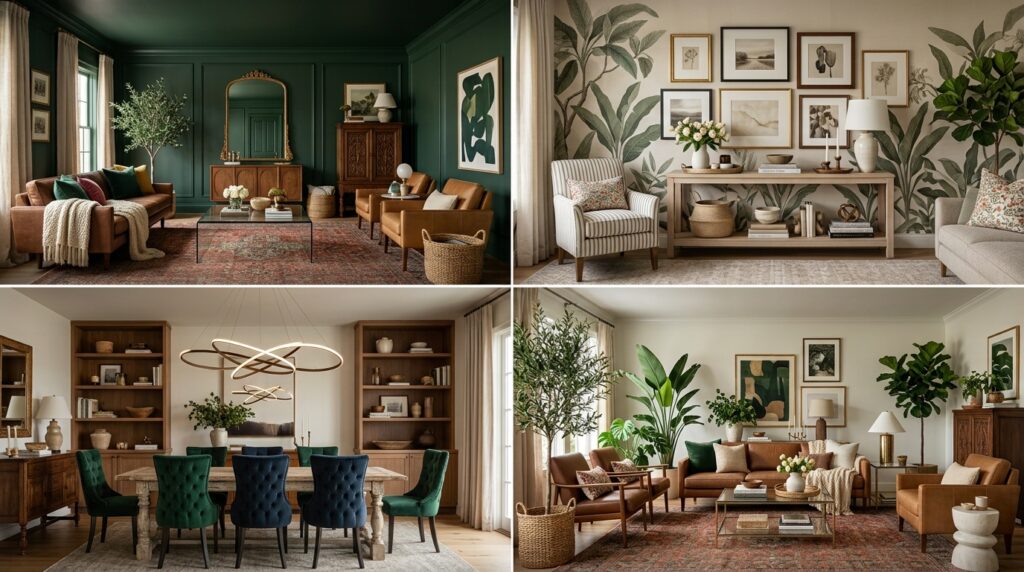
A chaotic room is usually suffering from a fragmented color palette. To anchor a diverse collection of furniture and decor, wrap the room in a single, deeply saturated, unifying color. A moody, enveloping shade – like a rich forest green, a deep aubergine, or a warm, earthy ochre – acts as a theatrical backdrop. When walls, trim, and sometimes even the ceiling are drenched in a single tone, it reduces the visual noise of the room’s architecture. Against a dark, grounding canvas, bright, mismatched objects suddenly look like jewels in a velvet box rather than clutter in a stark white box.
2. Strategic Era and Style Mixing
The most compelling rooms are those that span centuries. The secret to mixing eras is paying attention to silhouette and visual weight. Do not group all your heavy, antique wooden pieces on one side of the room and your light, modern metal pieces on the other. Disperse them evenly. Pair the robust, chunky form of an English roll-arm sofa with the airy, skeletal frame of a modern glass and steel coffee table. The success of era mixing relies entirely on the dialogue between opposites: hard and soft, heavy and light, ornate and simple.
3. Texture Balance for Tactile Warmth
Cozy eclecticism relies heavily on touch. If a room feels cold or disjointed, it is likely lacking textural variety. A successful eclectic space features a carefully calibrated mix of finishes. You must deliberately layer matte against shiny, rough against smooth. Drape a slubby, raw-silk throw over a buttery, worn-in leather chair. Place a highly polished, reflective brass lamp on a distressed, reclaimed wood sideboard. It is this friction between materials that generates the “cozy” atmosphere, drawing people in and making a space feel deeply lived-in.
4. The Discipline of Curating vs. Cluttering
Eclectic style is not a license to display everything you own. Curation is the art of leaving things out. Group smaller objects together on a tray to read as a single visual unit rather than scattered debris. Use the “rule of three” when arranging items on a console or shelf, varying the heights to create a miniature skyline. If you acquire a new, beautiful object, adopt a “one in, one out” policy to maintain the delicate balance of the room. True coziness requires breathing room.
5. Constructing the Grounded Gallery Wall
A gallery wall is a staple of eclectic design, but it is often the quickest path to a messy-looking room. To keep a collection of art cohesive, you must apply constraints. You can mix frames – ornate gold, sleek black, raw wood – but keep the subject matter or color palette unified. Alternatively, you can hang wildly diverse art – oil portraits, abstract sketches, typography – but strictly unify them with identical frames. Furthermore, always anchor the gallery wall to a piece of furniture below it, such as a credenza or a sofa, ensuring the overall shape of the gallery relates to the furniture’s width.
6. Exploiting Vintage-Modern Tension
One of the most effective ways to establish an eclectic look is to create a direct standoff between an antique and a hyper-modern piece. This is where design becomes thrilling. Suspend a sharp, geometric, LED chandelier directly over a crumbling, highly distressed 18th-century dining table. The modernity of the light fixture highlights the patina and history of the wood, while the age of the table prevents the lighting from feeling sterile. This tension is the lifeblood of editorial interior design.
7. Navigating Pattern Layering Rules
Mixing patterns terrifies many homeowners, but it is essential for a cozy eclectic space. The rule for layering patterns without inducing a headache is all about scale. Never mix two large-scale patterns; they will fight for attention. Instead, combine a large, dominant pattern (like a bold botanical wallpaper or an oversized geometric rug) with a medium-scale pattern (like a classic stripe or plaid on a chair), and finish with a small, dense pattern (like a tiny ditsy floral or a subtle herringbone on throw pillows). This hierarchy allows the eye to process the patterns sequentially rather than all at once.
8. Unifying Disparate Elements with Wood Tones
Wood serves as a natural neutralizer in an eclectic space. While you shouldn’t buy matching bedroom sets, unifying your mixed wood tones helps ground a chaotic room. You do not need to match the woods perfectly, but you should identify the undertones. Keep warm woods (like cherry, mahogany, and warm oak) grouped together, or cool woods (like ash, grey-washed pine, and walnut) communicating with each other. A consistent undertone bridges the gap between furniture from wildly different eras.
9. Treating Statement Lighting as Sculpture
In a layered, eclectic room, flush-mount builder-grade lighting will immediately cheapen the aesthetic. You must view lighting as suspended sculpture. An oversized, dramatic light fixture can single-handedly organize a diverse room. Whether it is a giant mid-century sputnik chandelier, a massive woven rattan pendant, or a vintage Murano glass fixture, an oversized central light draws the eye upward and provides a central axis around which the rest of the room’s diverse elements can orbit peacefully.
10. The Grounding Power of Biophilic Elements
When a room contains heavy patterns, mixed metals, and diverse furniture styles, it needs a palate cleanser. Houseplants and natural greenery are the ultimate neutralizers in an eclectic scheme. Large, architectural plants like an olive tree, a towering bird of paradise, or a trailing pothos soften harsh architectural lines and blur the boundaries between different furniture styles. The organic, unpredictable shapes of nature add the final layer of coziness, ensuring the room feels vibrant, breathing, and completely unpretentious.
Frequently Asked Questions
How do I know if I’ve added too much to an eclectic room?
The best diagnostic tool is the “first glance” test. Take a photo of your room from the doorway. When you look at the photograph, your eye should immediately find a focal point (a fireplace, a large piece of art, or a bold sofa), and then smoothly travel around the room to secondary moments of interest. If your eye darts erratically around the photo without finding a place to land, or if the photo feels claustrophobic, you have crossed the line from curated to cluttered. Begin by editing out the smallest objects first, and ruthlessly clear off at least one major surface.
Can I mix more than two distinct design styles in one space?
Yes, but it requires a very strict adherence to color cohesion. You can mix Bohemian, Industrial, and Art Deco in a single room, but only if you severely restrict the color palette to, for example, just camel, charcoal, and brass. The more design eras and styles you introduce, the tighter your color palette must become to compensate. If you introduce multiple styles and multiple bold colors, the room will inevitably fracture and look disorganized.
What is the easiest way to transition a stark minimalist room into a cozy eclectic one?
Do not attempt to overhaul the room in a single weekend; eclectic spaces need time to develop patina. Start by replacing your textiles. Swap out plain, flat-weave rugs for vintage, hand-knotted Persian or Turkish rugs, which immediately introduce history, pattern, and color. Next, change your lighting; replace modern, sterile lamps with vintage or sculptural alternatives. Finally, begin swapping out generic wall art for original pieces, vintage oils, or dimensional objects like mirrors and woven textiles. The foundation of your minimalist room will actually serve as an excellent “negative space” canvas for these new, character-rich additions.